
PP FRP Tanks for STP
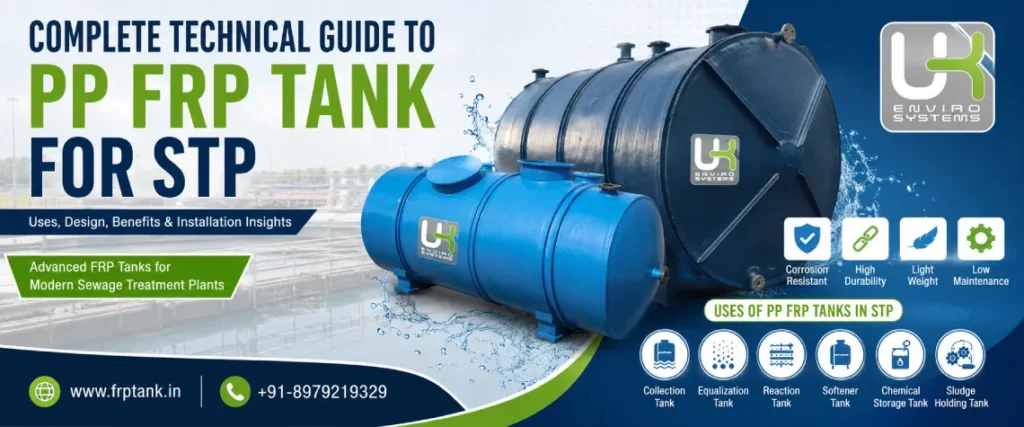
PP FRP Tank for STP represents a critical innovation in modern sewage treatment infrastructure. UK Enviro Systems manufactures these advanced tanks with precision engineering. These tanks combine polypropylene (PP) and fiber-reinforced plastic (FRP). The hybrid construction delivers exceptional chemical resistance. It also provides superior mechanical strength. Sewage treatment plants (STPs) require durable storage solutions. This tank meets those demanding operational needs effectively.
Understanding PP FRP Composite Technology
PP FRP STP Tanks use a dual-layer construction method. The inner layer consists of polypropylene. This material resists corrosive sewage components. Hydrogen sulfide and organic acids cannot degrade it easily. The outer layer uses FRP. FRP provides structural integrity. It also protects against external environmental stress. This combination creates a synergistic effect. Each material compensates for the other’s limitations.
Material Properties and Chemical Resistance
Polypropylene exhibits excellent resistance to weak acids. It also withstands bases and organic solvents. The operating temperature ranges from -10°C to 80°C. FRP adds UV resistance and impact strength. Together, they form a barrier against galvanic corrosion. Sewage contains ammonia, chlorides, and sulfates. These chemicals attack metal tanks aggressively. PP FRP tanks remain unaffected. Their service life exceeds 20 years under normal conditions.
Manufacturing Process of PP FRP Tanks
The manufacturing involves filament winding technology. First, technicians create an inner PP liner. They use extrusion welding for seamless joints. Then they apply FRP layers over the PP surface. The winding process ensures uniform fiber distribution. Resin saturation occurs under controlled conditions. Curing follows at specific temperatures. Post-curing inspection checks for voids or delamination. Quality control includes hydrostatic pressure testing. Each tank meets ISO and ASTM standards.
Design Specifications for Sewage Treatment Applications
PP FRP Storage Tank for Sewage Treatment Plant requires specific design parameters. The tank geometry depends on flow rates. Typical capacities range from 1,000 liters to 200,000 liters. Cylindrical vertical designs dominate the industry. Flat-bottom or dished-bottom configurations are available. Wall thickness varies from 6 mm to 25 mm. Thicker walls handle higher hydrostatic pressures.
Structural Analysis and Reinforcement
Engineers calculate stress distribution using finite element analysis. Hoop stress determines the reinforcement requirements. Longitudinal stress affects the vertical support design. External stiffeners prevent buckling under vacuum conditions. Nozzle orientations follow client specifications. Manways provide access for cleaning and inspection. Lifting lugs facilitate installation and relocation.
Connection Systems and Fittings
Flanged connections use PP or FRP materials. Gaskets made of EPDM or Viton ensure leak-proof seals. Threaded inserts accommodate instrumentation. Level sensors, pH probes, and temperature gauges integrate seamlessly. Overflow pipes prevent overfilling incidents. Drain valves at the bottom enable complete evacuation. Vent lines release trapped gases safely.
Role in Sewage Treatment Plant Operations
Sewage Treatment Plant Equipment includes multiple unit processes. PP FRP tanks serve various functions within STPs. Equalization tanks balance inflow variations. Chemical dosing tanks store coagulants and flocculants. Clarifier feed tanks regulate flow to sedimentation units. Sludge holding tanks accumulate digested biosolids. Treated effluent tanks store final discharge water.
Chemical Dosing Applications
STP Chemical Dosing Tanks require specific features. Chemicals like alum, ferric chloride, and polymers are aggressive. PP FRP construction prevents chemical attack. Dosing tanks include agitators for mixing. Recirculation lines maintain suspension uniformity. Calibrated level indicators show chemical volume. Secondary containment trays catch accidental spills. Material compatibility charts guide chemical selection.
Biological Treatment Support
Biological processes need controlled environments. Anoxic tanks use PP FRP for denitrification stages. Aerobic tanks resist oxygen-induced oxidation. Membrane bioreactor (MBR) equalization tanks handle mixed liquor. The non-porous surface prevents biofilm adherence. Cleaning becomes easier with smooth interior walls. Sanitary design reduces bacterial contamination risks.
Technical Advantages Over Conventional Materials
Concrete tanks suffer from cracking and leaching. Steel tanks corrode within five years. Stainless steel grades like 316L still pit in chloride-rich sewage. PP FRP offers superior longevity. Weight comparison shows FRP is 80% lighter than concrete. Installation requires no heavy lifting equipment. Transport costs reduce significantly. Maintenance frequency drops by 60% compared to steel.
Thermal and Electrical Properties
PP FRP tanks act as thermal insulators. Heat loss through walls is minimal. This benefits anaerobic digestion processes. Electrical non-conductivity prevents stray current corrosion. No grounding systems are required for electrical safety. Lightning strikes cause less damage compared to metal tanks.
Leakage Prevention and Monitoring
Double-wall configurations provide secondary containment. Interstitial space allows leak detection sensors. Vacuum monitoring alerts operators to liner breaches. Hydrostatic testing validates integrity before commissioning. Welded seams undergo ultrasonic inspection. No gasketed joints exist in the primary containment zone.
Installation and Integration Guidelines
Site preparation requires a level concrete foundation. Anchor bolts secure the tank against wind uplift. Grout pads distribute load evenly. Pipe connections align with plant layout. Expansion joints accommodate thermal movement. Support brackets hold external piping. Walkways and ladders provide access to top manways.
Commissioning Procedures
Initial filling uses clean water at controlled rates. Strain gauges monitor wall deformation. Pressure testing confirms design margins. Chemical resistance verification uses coupon samples. Documentation includes material test certificates. Welder qualification records remain on file. As-built drawings show final dimensions and nozzle locations.
Operational Parameters
Maximum working pressure ranges from atmospheric to 5 bar. Vacuum rating up to full vacuum with stiffeners. Design temperature follows chemical service requirements. Cyclic loading from filling and emptying causes no fatigue failure. UV exposure requires exterior gel coat protection. Underground installations need cathodic protection assessment.
Maintenance and Inspection Schedules
Annual visual inspections check for surface erosion. Tap testing identifies delaminated areas. Thickness measurement using ultrasonic gauges tracks wear. Minor repairs use PP welding rods and FRP patching kits. Major refurbishment involves re-laminating external surfaces. Internal cleaning uses high-pressure water jets. Chemical cleaning avoids abrasive materials.
Failure Mode Analysis
Common failure modes include impact damage and chemical overexposure. Improper installation causes stress cracking. Thermal cycling above design limits creates micro-cracks. Abrasive solids wear down the PP liner. Preventing these issues requires operational discipline. Operator training programs reduce human errors. Spare parts inventory includes repair kits and gaskets.
Industry Standards and Certifications
PP FRP Tank Manufacturers for STP must follow recognized codes. BS 4994 specifies design of FRP vessels. ASME RTP-1 covers reinforced thermoset plastic tanks. DIN 6603 governs PP welding procedures. ISO 14692 addresses petroleum and chemical applications. Third-party inspections from add credibility. Fire resistance ratings meet Class 1 or Class 2 standards.
Quality Assurance Protocols
Raw material certificates verify resin and fiber grades. Production follows approved manufacturing procedure specifications. Weld coupons undergo tensile and bend testing. Dimensional checks ensure tolerance compliance. Final hydrostatic test holds for four hours. Shipping inspection confirms no transport damage. Installation supervision ensures correct assembly.
Comparative Cost Analysis
Initial capital cost exceeds carbon steel by 30%. However, lifecycle cost favors PP FRP significantly. Steel requires repainting every three years. Replacement occurs after eight years typically. Concrete needs crack sealing annually. PP FRP offers 20+ years with minimal upkeep. Insurance premiums are lower due to leak resistance. Downtime costs reduce by 80% over plant life.
Environmental and Safety Considerations
PP FRP tanks are recyclable at end of life. Manufacturing generates less CO2 than steel production. No heavy metal leaching into groundwater occurs. Fire safety improves with self-extinguishing resins. Operator exposure to sewage reduces with sealed systems. Spill containment features protect soil and water bodies. Compliance with environmental regulations becomes straightforward.
Case-Specific Design Modifications
High-solids sewage requires larger inlet nozzles. Grease-laden wastewater needs heated tanks. Acidic industrial effluent demands thicker PP liners. Abrasive grit requires wear-resistant FRP layers. Seismic zones need flexible supports. High-wind areas require additional anchor bolts. Freezing climates need insulation and trace heating.
Procurement Specifications for Buyers
Engineers should specify design pressure and temperature. Provide chemical composition of the sewage. State required service life in years. Mention seismic and wind load criteria. Request material test reports from PP FRP Tank Manufacturers for STP. Inspect factory before shipment. Verify welder certifications. Confirm hydrostatic test records.
Vendor Evaluation Checklist
Manufacturers need proven STP experience. Request previous installation references. Check quality management system certification. Evaluate lead time for custom sizes. Assess after-sales support capability. Compare warranty terms carefully. Visit existing installations if possible. Review complaint resolution history.
Future Trends in PP FRP Tank Technology
Nanocomposite resins improve barrier properties. Smart sensors embedded during layup monitor health. RFID tags track maintenance history. Automated winding reduces production defects. 3D printing of PP liners enables complex geometries. Biobased resins reduce environmental footprint. Self-healing polymers close micro-cracks automatically. These innovations will expand STP applications further.
Conclusion
PP FRP Tank for STP offers unmatched durability in sewage environments. UK Enviro Systems delivers these tanks with precision engineering. The hybrid construction resists corrosion and mechanical stress. STP operators benefit from reduced maintenance costs. Extended service life lowers total ownership expenses. Chemical dosing applications perform reliably without degradation. Installation simplicity reduces project timelines. Safety features protect both workers and the environment. As sewage treatment standards tighten globally, PP FRP technology provides a future-proof solution. Investing in quality tanks ensures uninterrupted plant operations. Contact UK Enviro Systems for customized STP tank solutions.