
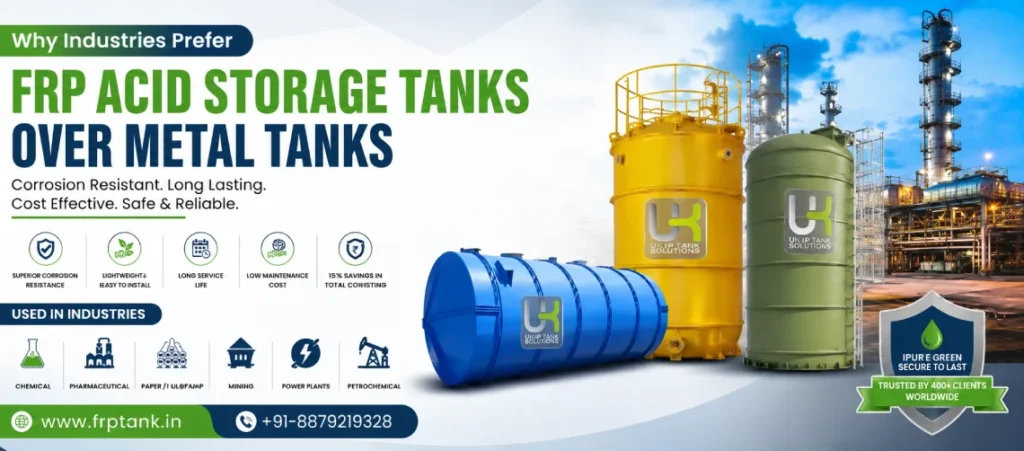
Why Industries Prefer FRP Acid Storage Tanks Over Metal Tanks

FRP Acid Storage Tanks

Industries worldwide face a critical decision for acid containment. FRP Acid Storage Tanks offer a superior solution. Metal tanks often fail under harsh chemical conditions. FRP Acid Storage Tanks provide long-lasting performance. This blog explains why engineers choose FRP over metal. We will explore technical, economic, and safety factors.

The Corrosion Challenge in Acid Storage

Acids aggressively attack most metals. This reaction causes rapid deterioration. Metal tanks develop pits, cracks, and leaks. Such failures risk production downtime. They also create environmental hazards.

How Metal Tanks Fail Under Acid Exposure

Steel tanks corrode when storing sulfuric acid. Stainless steel resists some acids but not all. Hydrochloric acid quickly destroys stainless steel. The corrosion releases hydrogen gas. This gas buildup increases explosion risks. Metal ions contaminate the stored acid. Consequently, industries lose product purity. Repairing metal tanks becomes expensive. Welding patches introduces new weak points. Eventually, complete replacement becomes necessary.

FRP Acid Storage Tanks Offer Superior Resistance

FRP stands for Fiber-Reinforced Plastic. This composite material resists almost all acids. The resin matrix provides chemical inertness. Glass fibers add mechanical strength. Together, they create a corrosion-resistant barrier. Therefore, FRP Acid Storage Tanks do not rust or pit. They maintain structural integrity for decades. Even concentrated acids cause no damage. For example, 98% sulfuric acid stores safely in FRP. Hydrochloric acid up to 37% poses no problem. Nitric acid storage also works well. This chemical resistance makes FRP the top choice.

Weight and Structural Advantages

Weight significantly impacts storage system design. Metal tanks weigh many tons. FRP tanks weigh a fraction of that. This difference changes everything.

Comparing Density and Handling

Steel has a density of 7.8 g/cm³. FRP has a density of only 1.5 to 1.9 g/cm³. An FRP tank weighs 75% less than steel. This lightweight property reduces transportation costs. Crane requirements become smaller. Foundation loads decrease substantially. Consequently, installation proceeds faster and cheaper.

Installation Benefits of Lightweight Tanks

Heavy metal tanks need reinforced foundations. These foundations cost thousands of dollars. FRP tanks sit on simple concrete pads. Installation crews work without heavy lifting gear. Assembly time reduces by half. Moreover, modular FRP sections allow on-site assembly. This flexibility helps confined spaces. Roof access becomes feasible with FRP. Metal tanks often cannot enter existing buildings. FRP solves this logistic problem.

Cost Efficiency Over the Lifecycle

Initial purchase price tells only part of the story. Lifecycle costs determine true value. FRP Acid Storage Tanks win this comparison.

Initial Purchase vs Long-Term Savings

Metal tanks have lower upfront costs sometimes. However, FRP prices remain competitive. For large diameters, FRP costs less. But the real savings come later. A metal tank needs replacement every 5-10 years. An FRP tank lasts 25 years or more. Therefore, one FRP tank replaces three metal tanks. This longevity saves capital repeatedly. Also, maintenance costs drop dramatically.

Maintenance and Repair Costs

Metal tanks require regular painting and coating. These coatings fail at pinhole defects. Each repair needs shutdown and cleaning. FRP tanks need no external coating. Their surface resists UV degradation. Cleaning requires only water rinsing. Minor damage repairs quickly. A simple resin patch restores integrity. No welding or hot work permits needed. Consequently, maintenance budgets shrink by 70%.

Customization by Acid Storage Tank Manufacturers

Standard tank sizes fit some applications. But industrial needs vary widely. Acid Storage Tank Manufacturers offer custom FRP solutions.

Design Flexibility with FRP

FRP fabrication uses molds and lay-up techniques. Manufacturers can create any shape. Cylindrical, rectangular, or conical designs work. Nozzle placements occur anywhere. Manways fit operator requirements. Internal baffles control liquid movement. External ribs add strength where needed. Metal tanks cannot match this flexibility. Each custom metal tank needs expensive tooling. FRP molds cost a fraction.

Meeting Specific Industrial Requirements

High-purity acid storage demands smooth interiors. FRP provides seamless inner surfaces. These surfaces prevent bacterial growth. They also eliminate crevice corrosion. PP FRP Acid Storage Tanks combine polypropylene and FRP. This hybrid offers extreme chemical resistance. Polypropylene liners handle aggressive acids. The FRP outer shell provides structural support. Such designs suit pharmaceutical applications. Semiconductor plants also prefer PP FRP. Metal cannot achieve this purity level.

Thermal and Mechanical Performance

Temperature and pressure affect tank selection. FRP performs well in demanding conditions.

Temperature Resistance of FRP

Different resin systems handle different temperatures. Vinyl ester resins withstand 100°C continuously. Epoxy resins tolerate 120°C. For higher temperatures, phenolic resins work. Metal tanks suffer from thermal expansion. This expansion creates stress at joints. FRP has a similar expansion coefficient to concrete. Therefore, thermal cycling causes no damage. Insulation layers bond directly to FRP. Metal requires separate insulation attachments.

Strength Under Pressure

Industrial Acid Storage Tanks must hold liquid pressure. FRP tanks achieve high strength-to-weight ratios. Hoop winding creates incredible burst strength. A 4-meter diameter FRP tank handles 10 bar pressure. Axial strength comes from longitudinal fibers. Impact resistance also proves excellent. Metal dents permanently upon impact. FRP flexes and returns to shape. This resilience prevents catastrophic failures. Even earthquake forces get absorbed safely.

Safety and Environmental Considerations

Worker safety drives equipment choices. Spill prevention protects the environment. FRP excels in both areas.

Leak Prevention and Spill Control

Metal tanks develop pinhole leaks over time. These leaks go undetected until major spills occur. FRP tanks have no such failure mode. The monolithic construction eliminates seams. Secondary containment integrates into FRP designs. Double-wall tanks provide leak detection. The annular space monitors continuously. Any leak triggers an immediate alarm. Spill risk drops to near zero. Environmental regulators approve FRP readily.

Non-Reactive Nature of FRP

Acid spills on metal create hydrogen gas. This gas ignites from static sparks. FRP does not react with acids. No hydrogen generates during spills. Fire hazards reduce significantly. Additionally, FRP resists galvanic corrosion. Metal tanks connected to pipes suffer galvanic damage. FRP acts as an electrical insulator. This property prevents stray current corrosion. Underground installations benefit greatly.

Role of Acid Storage Tank Suppliers in Quality Assurance

Not all FRP tanks perform equally. Acid Storage Tank Suppliers vary in quality. Choosing certified suppliers matters.

Standards and Certifications

Reputable suppliers follow ASTM standards. D3299 specifies filament-wound tanks. D4097 defines contact-molded tanks. Third-party inspections verify compliance. ASME RTP-1 certification exists for thermoset tanks. European EN 13121 standards also apply. Suppliers provide material test reports. Each tank receives a design stamp. This documentation satisfies insurance requirements. Chemical Storage Tank Manufacturers with ISO 9001 ensure consistent quality.

Material Selection for PP FRP Acid Storage Tanks

Resin selection depends on acid type. Isophthalic polyester suits dilute acids. Vinyl ester handles oxidizing acids. Bisphenol-A fumarate resists bleaches. For hydrofluoric acid, special liners are needed. Glass fiber types also matter. E-glass works for most applications. C-glass offers better acid resistance. Suppliers recommend the correct combination. They perform coupon testing when needed. This scientific approach prevents field failures.

Industrial Applications of FRP Acid Storage Tanks

Many sectors rely on FRP for acid storage. Each application benefits uniquely.

Chemical Processing Plants

Chemical plants store multiple acid types. Sulfuric acid for alkylation processes. Nitric acid for fertilizer production. Phosphoric acid for food additives. A single plant may have 50 FRP tanks. Metal tanks would corrode within months. FRP tanks last the plant lifetime. Changeovers between acids become safe. A quick rinse prepares the tank. Metal would retain acid residues.

Metal Treatment Facilities

Steel pickling uses hydrochloric acid. Galvanizing lines use sulfuric acid. Anodizing shops use chromic acid. These operations demand Corrosion Resistant Storage Tanks. FRP handles all these acids. The tanks resist fumes as well. External surfaces stay clean. Metal tanks in same buildings rust rapidly. Maintenance crews prefer FRP for safety. No rust particles fall into baths.

Why Leading Chemical Storage Tank Manufacturers Recommend FRP

Engineers have decades of failure data. These data show clear patterns.

Case for Replacement of Metal Tanks

A Midwest chemical plant replaced 20 steel tanks. The steel tanks failed after 7 years. New FRP tanks cost 30% more initially. However, after 15 years, the FRP tanks still worked. The plant saved $2 million in replacements. Another facility stored 93% sulfuric acid. Their rubber-lined steel tank leaked repeatedly. An FRP tank solved all issues. No leaks occurred in 12 years. These cases repeat across industries.

Long-Term Reliability Data

The FRP industry maintains performance records. Average service life exceeds 25 years. Some tanks operate for 40 years. Failure rates sit below 0.5% per year. Metal tank failure rates exceed 5% annually. These numbers drive insurance premiums. FRP tanks qualify for lower rates. Auditors recognize FRP as best practice. Consequently, new plants specify FRP exclusively.

Conclusion

Industries prefer FRP Storage Tanks for compelling reasons. Corrosion resistance tops the list. Lightweight construction reduces costs. Long service life delivers value. Customization meets any requirement. Safety benefits protect workers. Environmental compliance becomes easier. Acid Storage Tank Manufacturers continue improving FRP technology. New resin systems handle higher temperatures. Advanced fibers increase strength. Acid Storage Tank Suppliers offer complete solutions. They provide design, fabrication, and installation. Chemical Storage Tank Manufacturers agree on one fact. FRP outperforms metal for acid storage. PP FRP Acid Storage Tanks serve extreme conditions. Industrial Acid Storage Tanks made from FRP dominate modern facilities. Corrosion Resistant Storage Tanks in FRP represent industry standard. Make the switch today. Your operations will benefit for decades.

At UK Enviro Systems, we deliver top-quality FRP Acid Storage Tanks worldwide. Contact our team for your specific requirements.

Frequently Asked Questions

UK Enviro Systems leads globally, including India, with certified FRP acid storage tanks for corrosive chemicals.

FRP (Fiber-Reinforced Plastic) is best due to its corrosion resistance, lightweight strength, and long service life.

FRP tanks never rust or pit from acids, weigh 75% less than steel, and last 25+ years without frequent repairs.

Properly fabricated FRP acid storage tanks typically last 25 to 40 years, even with concentrated acids.

Cost varies by size and resin type, but FRP tanks offer 70% lower lifetime cost than metal due to zero corrosion maintenance.

Yes, FRP tanks safely store 98% sulfuric acid using vinyl ester or phenolic resin systems with no hydrogen generation.

PP FRP tanks combine polypropylene liners for extreme chemical resistance and FRP shells for structural strength.

Calculate daily acid consumption, delivery frequency, and emergency buffer. UK Enviro Systems customizes any capacity.

Absolutely. FRP tanks handle 37% hydrochloric acid without pitting, unlike stainless steel which fails rapidly.

Chemical processing, metal treatment (pickling), fertilizer production, semiconductor manufacturing, and pharmaceutical plants.