
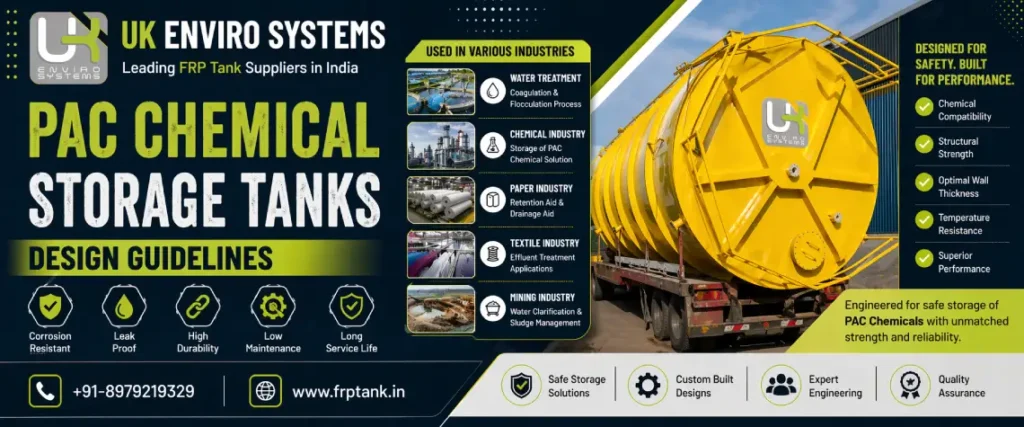
For industries handling poly aluminium chloride, finding trusted PAC Storage Tank Manufacturers ensures safe operations. UK Enviro Systems delivers high-quality FRP tanks worldwide. Proper design prevents leaks and failures. This guide covers essential design rules for PAC chemical storage.
Understanding Poly Aluminium Chloride Storage Needs
Poly aluminium chloride (PAC) is a common coagulant. Water treatment plants use it widely. PAC removes impurities from water. It also clarifies industrial effluents. However, PAC has corrosive properties. Therefore, proper storage becomes critical. PAC Storage Tanks must resist chemical attack. Otherwise, tank failure occurs quickly.
Chemical Properties of PAC
PAC contains aluminium ions and chloride. The solution has low pH levels. Typically, pH ranges from 3.5 to 5.0. Consequently, PAC acts as a mild acid. Long-term exposure damages metals. Many materials degrade rapidly. For example, carbon steel rusts inside PAC. Stainless steel also shows pitting. Thus, Poly Aluminium Chloride Storage Tanks need special materials.
Why FRP Tanks Work Best
Fiberglass reinforced plastic (FRP) offers excellent resistance. FRP does not react with PAC. Moreover, FRP Tanks are lightweight. They withstand high pressures too. PAC Chemical Storage Tanks benefit from FRP construction. Additionally, FRP allows custom shapes. Manufacturers can adjust wall thickness. This flexibility suits many industrial sites.
Key Design Parameters for PAC Storage Tanks
Designing PAC Storage Tanks requires careful planning. Engineers must consider several factors. Each factor impacts safety and longevity. Below are the most important parameters.
Material Selection for PAC Chemical Storage Tanks
The inner liner needs corrosion resistance. Vinyl ester resins work well. Isophthalic polyester resins also perform adequately. However, orthophthalic resins fail quickly. Therefore, choose high-grade resins. The liner thickness should exceed 2.5 mm. Aluminium Chloride Storage Tanks require this protection. Otherwise, blistering occurs within months.
Resin Types and Corrosion Resistance
Different resins offer different benefits. Vinyl ester handles high temperatures. It resists up to 100°C. Isophthalic polyester works below 60°C. Both resins resist PAC effectively. Nevertheless, verify compatibility with suppliers. Liquid PAC Storage Tanks often use vinyl ester. This choice ensures longer service life.
Structural Integrity for Industrial PAC Tanks
Industrial PAC Tanks face mechanical stresses. Wind loads and seismic forces act on tanks. Additionally, liquid pressure increases with depth. Engineers calculate hoop stress carefully. The tank must not bulge or crack. FRP provides high strength-to-weight ratio. Consequently, failures remain rare with proper design.
Wall Thickness and Reinforcement
Wall thickness depends on tank diameter. A 2-meter diameter tank needs 6 mm thickness. Larger tanks require proportionally thicker walls. Engineers add ribs or stiffeners. These reinforcements prevent buckling. PAC Solution Storage Tanks over 4 meters tall need extra support. Finite element analysis helps optimize designs.
Bottom and Nozzle Design
The tank bottom experiences the highest stress. A dished bottom distributes load evenly. Flat bottoms need thicker plates. Nozzles for inlet and outlet require careful reinforcement. Poor nozzle design causes cracks. Many PAC Storage Tank Manufacturers use integrally molded nozzles. This method eliminates weak joints.
Safety Features for Liquid PAC Storage Tanks
Safety remains the top priority. PAC spills harm workers and environment. Therefore, Liquid PAC Storage Tanks include multiple safety features. Each feature reduces risk significantly.
Venting and Overflow Systems
PAC storage requires proper venting. Gas can build up inside tanks. Vent pipes release pressure safely. Use a vent scrubber for acidic fumes. Overflow lines direct excess liquid to a containment area. Never block overflow outlets. Acid Storage Tanks follow similar rules. Regular inspection keeps vents clear.
Secondary Containment
Every Chemical Storage Tank needs secondary containment. A concrete dike works well. The dike volume must exceed tank capacity. Alternatively, use double-walled tanks. This design holds leaks internally. Spill detection sensors alert operators quickly. Secondary containment saves lives and property.
Temperature Control for PAC Storage
PAC degrades at extreme temperatures. High heat accelerates corrosion. Low temperatures increase viscosity. Ideal storage range is 5°C to 40°C. Insulate Poly Aluminium Chloride Storage Tanks in cold climates. Use cooling jackets in hot regions. Temperature monitoring systems provide alerts.
UV Protection for Outdoor Tanks
Sunlight damages FRP materials. UV rays cause surface degradation. Therefore, outdoor tanks need UV protection. Add a UV-stabilized gel coat. Paint tanks with light-reflecting colors. White paint reduces heat absorption. Covered storage extends tank life. Many PAC Storage Tank Manufacturers offer UV-resistant finishes.
Installation and Maintenance of Aluminium Chloride Storage Tanks
Proper installation prevents future problems. Maintenance ensures continuous operation. Follow these guidelines for best results.
Foundation Requirements for Industrial PAC Tanks
Tank foundations must be level and strong. Concrete pads work best. The pad should extend 300 mm beyond tank edges. Provide drainage channels around the pad. Anchor bolts secure tanks against wind uplift. Industrial PAC Tanks on soft soil need pile foundations. Consult structural engineers before installation.
Piping Connections and Flexibility
Pipes connect to tanks through nozzles. Use flexible couplings for thermal expansion. Rigid pipes cause nozzle stress. Support all piping independently. Valves should be easily accessible. Color-code pipes for safety. Red for PAC lines, blue for water lines. Clear labeling prevents errors.
Inspection Protocols for PAC Solution Storage Tanks
Regular inspections catch problems early. Perform visual checks monthly. Look for cracks, blisters, or discoloration. Measure wall thickness annually. Use ultrasonic testing equipment. Check all gaskets and seals. Replace worn parts immediately. PAC Solution Storage Tanks need documentation of each inspection.
Cleaning and Flushing Procedures
Empty tanks before cleaning. Neutralize residual PAC with sodium bicarbonate. Rinse thoroughly with water. Use low-pressure water jets. Never use metal scrapers inside tanks. Soft brushes prevent surface damage. Inspect the liner after cleaning. Record cleaning dates and findings.
Compliance and Standards for Chemical Storage Tanks
Manufacturers must follow industry standards. Compliance ensures safety and legality. Below are key standards for PAC storage.
Industry Certifications for PAC Storage Tank Manufacturers
Look for ISO 9001 certification. This confirms quality management. ASTM D3299 covers FRP tank design. ASME RTP-1 provides additional guidelines. UK Enviro Systems meets all these standards. PAC Storage Tank Manufacturers with certifications deliver reliable products.
Environmental Regulations
PAC spills require reporting. Secondary containment is mandatory in many regions. Groundwater protection laws apply. Install leak detection systems. Maintain spill response kits on site. Train employees for emergency actions. Compliance avoids heavy fines.
Material Testing and Quality Assurance
Each tank batch requires testing. Resin samples verify chemical resistance. Laminate coupons measure strength. Hydrostatic testing confirms leak-tightness. Perform tests at 1.5 times operating pressure. Document all results. Aluminium Chloride Storage Tanks with test certificates give peace of mind.
Choosing the Right PAC Solution Storage Tanks Supplier
Selecting a supplier matters greatly. Poor quality tanks cause disasters. Therefore, evaluate suppliers carefully. UK Enviro Systems provides transparent information. Ask for material certifications. Request references from past clients. Visit manufacturing facilities if possible.
Quality Assurance from PAC Storage Tank Manufacturers
Reputable PAC Storage Tank Manufacturers follow strict QA processes. They test every production batch. They provide detailed design drawings. They offer warranty coverage. A typical warranty lasts five years. Some extend to ten years. Avoid suppliers without quality documentation.
Customization Options for Chemical Storage Tanks
Every plant has unique needs. Standard tanks may not fit. Therefore, seek custom designs. Adjust nozzle positions and sizes. Add manways for easy access. Include level indicators and sampling ports. Chemical Storage Tanks should match your process exactly. UK Enviro Systems specializes in custom FRP tanks.
Operational Best Practices for PAC Storage
Proper operation extends tank life. Train operators thoroughly. Post operating instructions near tanks. Monitor fill levels continuously. Never exceed design pressure. Avoid sudden temperature changes. These practices prevent premature failure.
Handling Emergency Situations
Spills require immediate action. Evacuate the area first. Wear appropriate PPE. Neutralize spilled PAC with lime. Collect neutralized material safely. Report incidents to authorities. Practice emergency drills quarterly. Preparedness reduces harm.
Record Keeping for Liquid PAC Storage Tanks
Maintain detailed records. Include installation date and design specifications. Log all inspections and repairs. Record any incidents or near misses. Review records annually for trends. Good record keeping supports continuous improvement.
Conclusion
Designing PAC Storage Tanks requires technical expertise. Material selection drives performance. Structural integrity ensures safety. Compliance with standards avoids legal issues. Regular maintenance extends service life. UK Enviro Systems delivers tanks that meet all these guidelines. Contact us for your next PAC storage project. Trust our decades of FRP experience.