
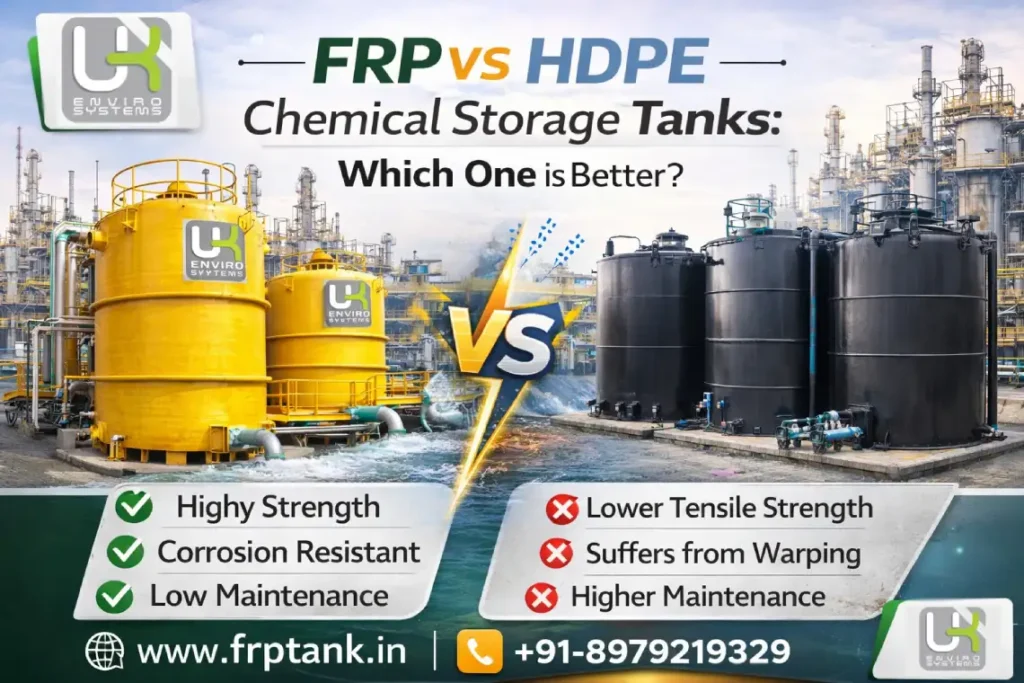
When industries seek reliable containment solutions, the choice often narrows down to two dominant materials. For businesses searching for HDPE Chemical Storage Tanks in Ghaziabad, the decision involves careful evaluation of performance, longevity, and chemical compatibility. This guide provides a detailed comparison to help you make an informed selection.
Understanding the Core Materials
Industrial storage tanks serve as the backbone of countless operations. The materials used in their construction directly impact safety, maintenance costs, and operational efficiency. Two leading options in the market are Fiber Reinforced Plastic (FRP) and High-Density Polyethylene (HDPE). Each brings distinct characteristics to the table.
The Composition of FRP Tanks
Fiber Reinforced Plastic combines a polymer matrix with reinforcing fibers. This combination creates a composite material known for its exceptional strength-to-weight ratio. FRP Storage Tank Manufacturers utilize layers of fiberglass impregnated with resin to build robust structures. The manufacturing process allows for customization in thickness, shape, and resin type to suit specific chemical environments.
The Composition of HDPE Chemical Storage Tanks
High-Density Polyethylene represents a thermoplastic polymer produced from petroleum. The material offers a high level of impact resistance and flexibility. Manufacturers create these tanks through rotational molding or extrusion techniques. The result is a seamless, monolithic structure that eliminates weak points found in welded joints.
Chemical Compatibility and Resistance
Chemical resistance stands as the most critical factor in storage tank selection. Different chemicals interact with tank materials in unique ways.
FRP Performance with Aggressive Chemicals
FRP excels in handling a wide spectrum of chemicals. The resin system can be tailored to resist specific substances. For applications involving strong acids, Acid Storage Tanks made from FRP provide exceptional durability. The material withstands corrosive environments that would degrade many other options. FRP also handles high temperatures better than most thermoplastics, making it suitable for processes involving heated chemicals.
HDPE Performance with Chemical Exposure
HDPE offers broad chemical resistance for many common industrial chemicals. The material performs well with bases, salts, and many organic compounds. However, certain strong oxidizing acids and organic solvents can affect HDPE over time. The operating temperature range for HDPE is lower than FRP, typically maxing out around 140°F (60°C) for continuous service.
Structural Strength and Durability
The structural integrity of a storage tank determines its lifespan and safety record.
FRP Structural Advantages
FRP provides superior structural strength in demanding applications. The composite construction resists deformation under heavy loads. For large capacity needs, Horizontal FRP Storage Tanks offer excellent stability and support. The material does not crack under stress like some thermoplastics. FRP tanks maintain their shape even when subjected to vacuum conditions or pressure variations.
HDPE Structural Characteristics
HDPE offers good impact resistance and flexibility. The material can absorb shocks without cracking. However, HDPE Chemical Storage Tanks require proper external support for large volumes. The material may creep or deform under continuous heavy loads. Wall thickness must increase significantly for larger capacities, which affects cost and weight.
Installation and Transportation
Logistics play a vital role in project planning and execution.
FRP Installation Considerations
FRP tanks offer versatility in transportation and installation. FRP Storage Tank Manufacturers can fabricate tanks in sections for field assembly. This capability allows for very large capacities that would be impossible to transport as single pieces. The lightweight nature of FRP reduces transportation costs and crane requirements. Field jointing techniques enable installation in challenging locations.
HDPE Installation Factors
HDPE tanks arrive as single-piece units for most sizes. This simplicity speeds installation but limits maximum size due to transportation constraints. Large HDPE Chemical Storage Tanks require specialized permits and equipment for delivery. The flexibility of HDPE allows for installation on uneven surfaces with proper preparation.
Cost Analysis Over Lifecycle
Initial purchase price represents only one component of total ownership cost.
FRP Cost Benefits
FRP tanks often require higher initial investment than HDPE equivalents. However, the extended service life in demanding applications justifies the expense. FRP tanks resist degradation from UV exposure without additional coatings. Maintenance requirements remain minimal over decades of service. The ability to repair FRP tanks onsite extends operational life further.
HDPE Cost Considerations
HDPE tanks typically offer lower upfront costs for standard applications. The material costs less per pound than FRP composites. However, replacement frequency may increase in aggressive chemical environments. UV stabilizers are necessary for outdoor installations, adding to long-term costs. Limited repair options mean damaged tanks often require full replacement.
Temperature Tolerance and Thermal Performance
Operating temperature significantly affects material performance and safety.
FRP Temperature Capabilities
FRP handles elevated temperatures effectively. Specialized resin systems allow continuous service at temperatures exceeding 200°F (93°C). The material maintains structural integrity during temperature fluctuations. Thermal expansion rates remain low, reducing stress on connections and supports.
HDPE Temperature Limitations
HDPE operates effectively within moderate temperature ranges. The material softens at elevated temperatures, reducing load-bearing capacity. Low temperatures increase brittleness and impact sensitivity. Thermal expansion rates are high, requiring careful design of pipe connections and anchoring systems.
Application-Specific Recommendations
Different industries present unique challenges that favor one material over another.
Water Treatment Applications
For Water Treatment Plant Tanks, both materials find common use. FRP dominates in applications involving chlorine, ozone, and other aggressive treatment chemicals. The material’s smooth interior surface resists biological growth and simplifies cleaning. For WTP Storage Tanks, FRP provides the structural strength needed for large volumes and chemical feed systems.
Acid Storage Requirements
Acid Storage Tanks demand exceptional corrosion resistance. FRP leads in this category due to customizable resin systems. Hydrochloric acid, sulfuric acid, and nitric acid all require careful material selection. FRP formulations specifically designed for these environments provide reliable long-term service.
General Chemical Storage
For Chemical Storage Tanks handling a variety of materials, FRP offers versatility. One tank design can accommodate changing product requirements over time. HDPE works well for dedicated applications with known, compatible chemicals.
Environmental and Safety Considerations
Modern industrial operations prioritize environmental protection and worker safety.
FRP Safety Features
FRP tanks provide inherent safety advantages in many scenarios. The material does not support combustion and offers flame-retardant properties. Secondary containment can be integrated into the tank design. Leak detection systems install easily within FRP structures. The material resists weathering and degradation that could lead to releases.
HDPE Safety Aspects
HDPE tanks offer safety through flexibility and impact resistance. The material does not rust or corrode in most environments. However, fire resistance is lower than FRP. HDPE burns when exposed to flame, potentially releasing combustion products. UV degradation must be managed to prevent brittleness and cracking.
Maintenance and Repair Capabilities
Long-term maintenance requirements affect operational continuity.
FRP tanks require minimal routine maintenance. Inspection focuses on surface condition and connection integrity. When damage occurs, repairs can be completed onsite using compatible resin systems. Skilled technicians can restore original strength and chemical resistance. The repairability of FRP extends tank life indefinitely in many cases.
HDPE Maintenance
HDPE tanks require inspection for UV damage and stress cracking. Repairs present significant challenges. Welding techniques require specialized equipment and clean conditions. Contaminated surfaces may prevent reliable repair. Replacement often represents the only practical solution for significant damage.
Customization and Design Flexibility
Every industrial application presents unique requirements.
FRP Customization Options
FRP Storage Tank Manufacturers offer extensive customization capabilities. Tank diameter, length, and wall thickness adjust to specific pressure and volume requirements. Nozzle locations, manways, and internal fittings integrate during fabrication. Horizontal FRP Storage Tanks can include internal baffles and specialized coatings. The design flexibility allows optimization for specific process conditions.
HDPE Customization Limitations
HDPE tanks offer limited customization options. Nozzle locations are predetermined by the molding process. Wall thickness varies with tank size but lacks the fine-tuning available with FRP. Post-fabrication modifications risk compromising structural integrity.
Making the Final Determination
The selection between FRP and HDPE depends on specific application parameters.
Choose FRP When
Select FRP for applications involving aggressive chemicals, elevated temperatures, or large volumes. Acid Storage Tanks handling strong mineral acids benefit from FRP construction. Water Treatment Plant Tanks with chemical feed systems favor FRP reliability. When long service life and repairability matter most, FRP delivers superior value.
Choose HDPE When
Select HDPE for applications with moderate temperatures and compatible chemicals. Small to medium volumes with straightforward installation benefit from HDPE simplicity. When initial budget constraints outweigh lifecycle considerations, HDPE offers an economical solution.
Quality Standards and Manufacturing Excellence
Working with established manufacturers ensures product reliability.
At UK Enviro Systems, our approach to tank manufacturing combines engineering expertise with quality materials. For businesses requiring HDPE Chemical Storage Tanks in Ghaziabad, we provide solutions that balance performance and value. Our FRP Storage Tank Manufacturers network ensures access to the highest quality composite tanks for demanding applications.
Our product range includes specialized solutions for every requirement. Horizontal FRP Storage Tanks provide efficient space utilization for large volume storage. Acid Storage Tanks feature resin systems formulated for maximum corrosion resistance. Chemical Storage Tanks from our facility serve diverse industries with reliable containment. For municipal and industrial clients, Water Treatment Plant Tanks and WTP Storage Tanks incorporate design features essential for treatment processes.
Final Considerations for Your Project
The decision between FRP and HDPE affects operational reliability for years to come. Evaluate your specific chemical compatibility requirements thoroughly. Consider the full lifecycle cost rather than initial purchase price alone. Factor in installation logistics and site conditions. Assess future needs for potential modifications or expansions.
Partnering with an experienced manufacturer ensures proper material selection and tank design. UK Enviro Systems brings decades of expertise to each project. Our team understands the nuances of both FRP and HDPE technologies. We help clients navigate the selection process with clear, practical guidance.
Contact us to discuss your specific storage requirements. Our engineers will help determine the optimal solution for your application. Whether you need HDPE Chemical Storage Tanks in Ghaziabad or specialized FRP systems, we deliver quality you can trust.