
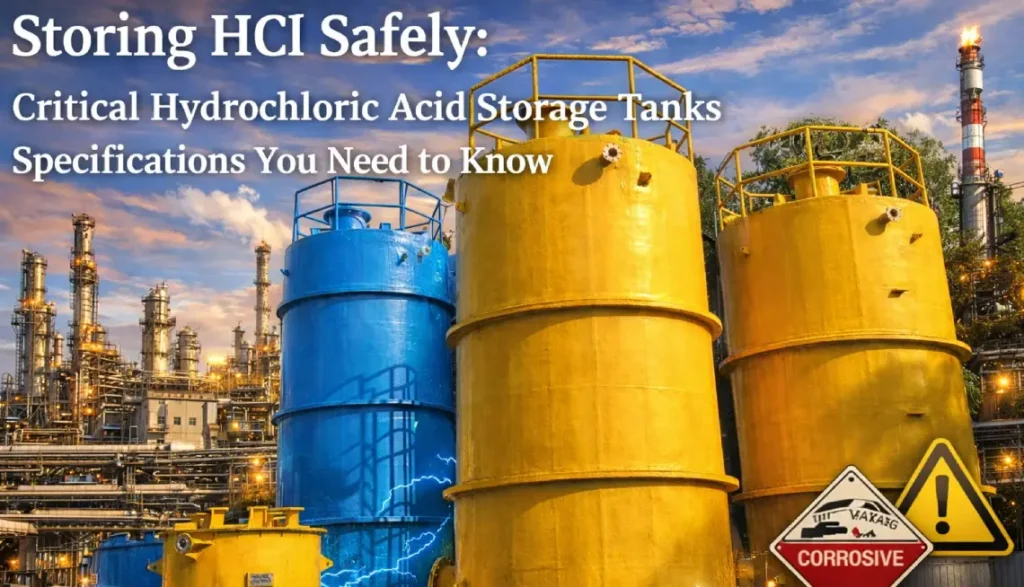
Hydrochloric Acid Storage Tanks
Handling hydrochloric acid (HCl) is a high-stakes responsibility. This powerful chemical drives essential processes like steel pickling, pH regulation, and ore processing. However, its aggressive nature poses significant risks to both personnel and infrastructure. A single failure in containment can lead to toxic fumes, environmental fines, and costly downtime. Therefore, selecting the right Hydrochloric Acid Storage Tanks is not merely a purchasing decision; it is a risk management strategy. At UK Enviro Systems, we understand that the specifications of your tank determine the safety of your entire facility. This guide explores the critical engineering parameters you must evaluate to ensure safe, long-term storage of this corrosive acid.
The Aggressive Nature of Hydrochloric Acid
Before diving into specifications, you must respect the chemistry involved. HCl is a reducing acid. It attacks most common metals aggressively. It also produces highly visible and corrosive fumes. These fumes can condense on external fittings and structural steel, causing corrosion outside the tank. Therefore, your storage solution must address both liquid containment and vapor management.
Why Material Selection Matters
Standard carbon steel corrodes rapidly when in contact with HCl. Stainless steel, surprisingly, also fails. The chlorides in the acid attack the oxide layer on stainless steel, leading to stress corrosion cracking. This leaves fiber-reinforced plastic (FRP) and certain thermoplastics as the only viable options. As a leading HCL Storage Tanks Manufacturer, we emphasize that the resin matrix must be specifically formulated to resist hydrochloric attack.
The Primary Standard: FRP Construction
For most industrial applications, FRP is the material of choice. However, not all FRP is the same. The specification lies in the details of the laminate.
The Corrosion Barrier
A high-quality tank features a specialized inner layer, often called the “corrosion barrier.” This layer is resin-rich and reinforced with a synthetic veil, typically made of C-glass or polyester. This veil prevents the acid from wicking into the structural fibers via capillary action. For HCl storage, the corrosion barrier must be at least 3 to 4 mm thick. It acts as the first line of defense, absorbing the chemical attack so the structural layer behind it remains uncompromised.
The Structural Laminate
Behind the corrosion barrier lies the structural laminate. This layer uses glass fibers to provide mechanical strength. The resin in this layer must match the corrosion barrier’s chemistry. If the resin in the structural layer differs, differential expansion or chemical degradation can cause delamination. You must specify a resin system with proven resistance to HCl at your specific storage temperature.
Secondary Containment: A Non-Negotiable Requirement
You cannot rely solely on the primary tank. A leak will eventually happen due to unforeseen circumstances. Secondary containment is your safety net.
The Importance of Diked Areas
Every HCl Acid Storage Tanks installation requires an impervious containment dike. This dike must hold 110% to 125% of the tank’s total volume. The floor of the dike must slope to a collection sump. This design allows you to pump out any leaked acid safely. The dike material must also resist acid attack. Lining concrete dikes with the same resin system used in the tank is a common and effective practice.
Double-Walled Tank Options
For facilities with limited space or extremely high environmental sensitivity, double-walled tanks are ideal. These tanks feature an inner tank for storage and an outer tank that acts as built-in secondary containment. Sensors placed in the interstitial space between the walls can detect leaks immediately. This design offers 360-degree protection against spills.
Design Pressure and Temperature Considerations
Hydrochloric acid does not sit still. It reacts to ambient conditions, creating pressure and vacuum scenarios inside the tank.
Venting for Safety
HCl fumes constantly. In a sealed tank, vapor pressure can build up significantly. Without proper venting, this pressure can rupture the tank. Conversely, during pump-out, a vacuum can form, potentially collapsing the tank. You must install a vent of adequate size. For many applications, a conservation vent with a pressure/vacuum relief valve is best. It minimizes fume escape while protecting the tank structure.
Temperature Ratings
The strength of FRP decreases as temperature increases. You must know the maximum operating temperature of your stored acid. Standard Hydrochloric Acid Storage Tanks might handle ambient temperatures well. However, if your process involves hot acid, you need a resin system with a higher heat distortion temperature. Operating above the design temperature accelerates corrosion and leads to premature structural failure.
Tank Orientation: Vertical vs. Horizontal
The physical layout of your facility often dictates the tank shape. However, each orientation has specific design implications.
Vertical Storage Tanks
Vertical cylindrical tanks are common for large volumes. They have a smaller footprint. However, they exert high pressure at the bottom due to the static head of the liquid. Therefore, the lower sidewalls require thicker laminate construction. The bottom joint, where the wall meets the floor, is a critical stress point and needs robust reinforcement.
Horizontal HCl Tanks
Horizontal tanks are often preferred for lower heights or transportability. They require saddle supports to distribute the weight evenly. Improper support design creates stress points that lead to cracking. When consulting Hydrochloric Acid Storage Tanks suppliers, ensure the saddle contact angle is wide enough (typically 120° to 180°) to support the loaded weight without deforming the shell.
Fittings and Accessories: The Devil in the Details
The tank shell might be perfect, but leaks often occur at fittings. Nozzles, manways, and instrument connections require careful specification.
Flange Integrity
All inlet and outlet flanges should be integrally molded with the tank wall. Avoid glued-on or attached flanges, as these bonds can fail. The flange face must be flat and stiff to allow for a proper gasket seal. Use materials like PTFE for gaskets, as they resist HCl attack.
Nozzle Loads
Pipes connected to the tank exert weight and stress on the nozzles. Heavy valves or pumps hanging directly on a tank nozzle can cause the nozzle to crack. You must support all piping independently. The tank nozzle should only experience minimal stress from the connection.
Manways for Inspection
You need access for internal inspection. A adequately sized manway (at least 18 inches to 24 inches) allows personnel to enter for maintenance. The manway cover should be lightweight yet strong, with a gasket sealing system that prevents fume leakage.
Specialized Resin Systems
The choice of resin defines the tank’s lifespan. For HCl, certain resin families perform better than others.
Vinyl Ester Resins
Vinyl ester resins are the workhorse for HCl storage. They offer excellent chemical resistance and good mechanical properties. They handle the reducing environment of hydrochloric acid effectively. For most ambient temperature applications, a standard bisphenol-A epoxy vinyl ester resin is suitable.
Polyester Resins
Isophthalic polyester resins might be cheaper, but they do not offer the same long-term resistance to HCl as vinyl esters. Using polyester can lead to faster degradation of the corrosion barrier. You should always verify the resin manufacturer’s chemical resistance guide for your specific acid concentration and temperature.
Novolac Resins
For elevated temperatures or higher concentrations, novolac vinyl ester resins provide superior performance. They have a higher cross-link density, making them more resistant to chemical attack and heat. If you are storing HCl above 50°C, you should strongly consider a novolac resin system.
Quality Assurance and Fabrication Standards
You need proof that the tank meets the specifications. Quality assurance involves testing at various stages.
The Importance of a Post-Cure
FRP tanks require a post-cure cycle after fabrication. This involves heating the tank to a specific temperature for a set period. Post-curing ensures the resin achieves its maximum chemical resistance and mechanical properties. Without a proper post-cure, the tank remains vulnerable to premature degradation. Reputable HCL Storage Tanks Customized Suppliers always include this step.
Spark Testing
Every interior surface should undergo a high-voltage spark test. This test identifies pinholes or voids in the corrosion barrier that are invisible to the naked eye. Any spark jumping indicates a defect that must be repaired before the tank enters service.
Maintenance and Inspection Protocols
Even the best tank requires vigilance. You cannot “set it and forget it” with HCl.
Regular Visual Inspections
Conduct monthly external inspections. Look for signs of “fiber bloom” or “whitening” on the exterior surface. These indicate that acid has penetrated the wall and is attacking the fibers from the inside. Also, check the foundation for signs of chemical spills or erosion.
Internal Inspections Schedule
Plan for a thorough internal inspection every 3 to 5 years. Empty, clean, and ventilate the tank thoroughly. Inspect the interior surface for blisters, cracks, or erosion. Use ultrasonic thickness testing to measure the remaining thickness of the corrosion barrier and structural wall. Compare these readings to the original specifications.
Partnering with the Right Manufacturer
The specifications on paper mean nothing without the craftsmanship to back them up.
Experience with HCl
Choose a manufacturer with a proven track record for HCl storage. Ask for references and case studies. A company that understands the nuances of fume management, thermal expansion, and resin chemistry will anticipate problems that a generalist might miss.
Customization Capabilities
Every facility is unique. You might need special lifting lugs, unusual nozzle orientations, or specific color codes. Working with flexible Hydrochloric Acid Storage Tanks Customized Suppliers ensures the tank integrates seamlessly into your existing operations. UK Enviro Systems specializes in tailoring solutions to fit precise site requirements.
Conclusion
Storing hydrochloric acid safely demands respect for the chemical and attention to engineering detail. From the initial selection of a vinyl ester resin to the integrity of the secondary containment dike, every specification plays a vital role. You cannot compromise on the corrosion barrier thickness or the quality of the fittings. A well-designed Hydrochloric Acid Storage Tanks system protects your employees, your community, and your bottom line. By understanding these critical specifications—material, design, orientation, and maintenance—you empower your facility to operate safely and efficiently. Trust in proven engineering and partner with manufacturers who prioritize safety as highly as you do. Your diligence in specifying the right tank today prevents the environmental disaster of tomorrow.